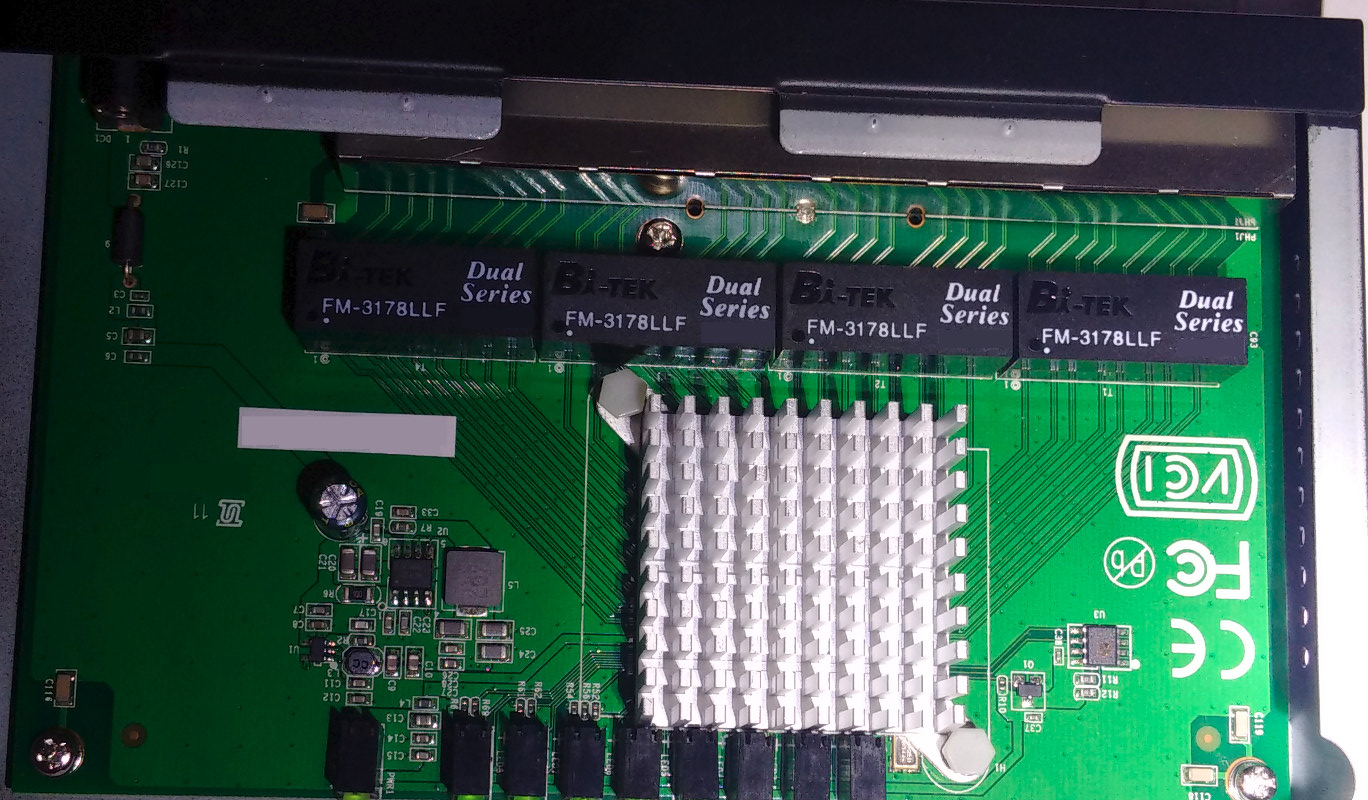
Unmanaged Gigabit switches are typically in the $20 cost range.
They generally don’t have 10/100/1000 Mbps speed indicator lights anymore, perhaps since most hardware is gigabit by default.
As multi-gigabit home and business internet connections become more common, ensure your network wouldn’t benefit from 2.5 Gigabit switches before locking into 1 Gigabit switches.
Model/Rev
LED speed indicator
metal jacks
buffer memory (kB)
MAC address table (entries)
TEG-S80g Rev 1.0
yes
yes
128
4K
TEG-S80g Rev 2.1
yes
yes
128
8K
TEG-S80g Rev 3.0
no
no
256
8K
TEG-S80g Rev 4.1
no
no
192
4K
TEG-S82g Rev 2.0
no
no
256
8K
NetGear GS308 v3
no
yes
192
8K
These switches have been reliable for me across many years of use in small instrument networks with challenging physical environments.
Git projects using
submodules
can be set to default shallow Git clone submodules to save space and time.
Edit the “.gitmodules” file to have the “shallow = true” option for each Git submodule.
This is particularly useful when the top-level project uses third party libraries or libraries with a large Git revision history.
Example .gitmodules file with shallow Git submodules:
A Fortran submodule may be defined in the same file or a different file than the Fortran module that uses the submodule.
Meta-build systems such as CMake and Meson are aware that each Fortran compiler has distinct Fortran submodule naming conventions.
Fortran module and submodule interface files are like generated header files.
GCC Gfortran module and submodule naming convention is defined in
module.cc
by definintions “MODULE_EXTENSION” and “SUBMODULE_EXTENSION”.
LLVM Flang module and submodule naming convention is defined in Semantics.
The table above can be derived from an
example project
or by the values of CMake variables CMAKE_Fortran_SUBMODULE_EXT and CMAKE_Fortran_SUBMODULE_SEP located in
<compilerName>-Fortran.cmake.
USB-C dock display adapters (HDMI, DisplayPort) are generally seen as a preferable replacement for proprietary docking ports on old bulky laptops.
A symptom is USB-C adapter works on one laptop, but not on another almost identical laptop model.
For Apple hardware, USB-C docks might only work with DisplayPort connection, not HDMI.
This may be because some USB-C docks use “DisplayPort Alternate Mode”, which macOS seems not to recognize with an HDMI connection even on the same monitor that works with a DisplayPort cable connection.
General symptoms across hardware and operating systems include the dock display not being detected by the operating system, to showing a black screen, or very low resolution.
The solution seems to be to stick with expensive OEM display adapters, or at least long established brands.
The temptation of a cheap adapter can quickly turn to frustration or botched presentations.
Another thing to watch for is cheap adapters may fail intermittently when using more than one high bandwidth feature.
For example, using Gigabit Ethernet and HDMI on the cheap USB-C adapter simultaneously may fail intermittently during a conference call or teaching a class, which can be frustrating.
Some adapters that charge the laptop with a USB-C input for power may experience improper operations if the display adapter is plugged into the laptop while the USB-C power input is powered.
This problem may persist upon re-plugging the adapter to laptop and/or power cycling the monitor and laptop.
A workaround we’ve found is to unplug USB-C power input to the adapter, plug into the laptop with all the desired accessories, then finally plug USB-C power input into the adapter.
That is unexpected, but has worked for us sometimes.
Intel oneAPI is a cross-platform toolset that covers several programming languages including C, C++, Fortran and Python.
Intel oneAPI includes the C++ “icpx” compiler, Fortran “ifx” compiler, Intel MKL, and Intel MPI.
oneAPI is free-to-use and no login is required to download and install.
The “online” installer can be copied over SSH to an HPC user directory for example and installed from the Terminal.
There are distinct usage patterns to access Intel oneAPI compilers on Windows vs. Linux.
Set environment variables CC, CXX, FC
via script.
oneapi-vars sets environment variable CMAKE_PREFIX_PATH so don’t just blindly overwrite that environment variable.
Windows requires Visual Studio Community to be installed first–VS IDE integration is optional.
For oneAPI ≥ 2025.3.1 and CMake ≥ 4.2, MSVC 2026 is supported.
Remarkably, oneAPI Windows on ARM installations work as well - except for VS IDE integration.
If VS IDE integration is installed,
cmake -G
can be used to
generate Visual Studio
project files with CMake 3.29 or newer.
Otherwise,
at least CMake 3.25.0
is adequate for oneAPI.
On Windows a Start menu shortcut for a oneAPI command prompt is installed.
Powershell can also use “oneapi-vars.bat” to set the environment variables as per the oneapi.ps1 in the Gist above.
If CMake Visual Studio generator is desired, ensure:
CMake ≥ 3.29 is used for the -T fortran=ifx option cmake -Bbuild -G "Visual Studio 17 2026" -T fortran=ifx
Intel oneAPI Visual Studio integrations are installed
If problems with finding packages with oneAPI on Windows and CMake occur, ensure that MSYS2 paths aren’t mixed in with the oneAPI environment.
See the project
CMakeConfigureLog.yaml
and look for unwanted paths in the include commands.
On Linux, oneAPI requires
GNU GCC toolchain.
Some HPC systems have a too-old GCC version default for Intel oneAPI.
This can cause problems with C++ STL linking.
If needed, set environment variable CXXFLAGS for
Intel GCC toolchain
in custom “oneapi.sh” like:
For popular code languages including Python, JavaScript, C/C++, Java, Go, Rust and
more,
for which Git chunk headers are defined (the user can define them) the Git history of code functions can be checked with the git log -L command to specify the
function name and file.
For example, to check the Git history of the “main” function in “main.c”:
git log -L :main:main.c
The
pickaxe
options -S and -G can also be used to check the Git history of code functions by searching for commits that added, modified or removed specific code patterns in the function.
For example, to check the Git history of commits that added, modified or removed a variable “hi” in the “main” function in “main.c”:
The COMMENT field of CMake’s
add_custom_target()
is intended to print messages during the build.
However, this field is a no-op when using
CMake Generators
like Ninja and GNU Make.
To reliably print messages during the build regardless of the Generator used,
create a custom echo command using CMake’s built-in cmake -E echo functionality.
Because of the ALL parameter, the touchtgt target will be built by default when you run cmake --build build, and it will print the message “Touch <path_to_output.txt>” during the build process.
To make the file be touched only if it doesn’t exist, use a combination of add_custom_command() and add_custom_target() instead:
The Google Drive local
client
creates a local filesystem mount for Google Drive files.
Accessing files not yet synced locally will trigger an on-demand sync of the file that takes time proportional to the file size.
The location of this folder is similar across operating systems:
Windows PowerShell: $HOME/Google Drive
macOS: ~/Google Drive
On Linux, clients such as
rclone
can mount Google Drive as a network drive.
Major projects with CPU arch-specific code may distribute binaries for multiple CPU architectures for operating systems.
Apple Silicon or Microsoft Prism are key examples of emulated binaries.
Programs, especially computational programs like Anaconda Python should have the native matching CPU arch software installed.
Example code to programatically
check
if a C++, GNU Octave, Matlab, or Python executable on: